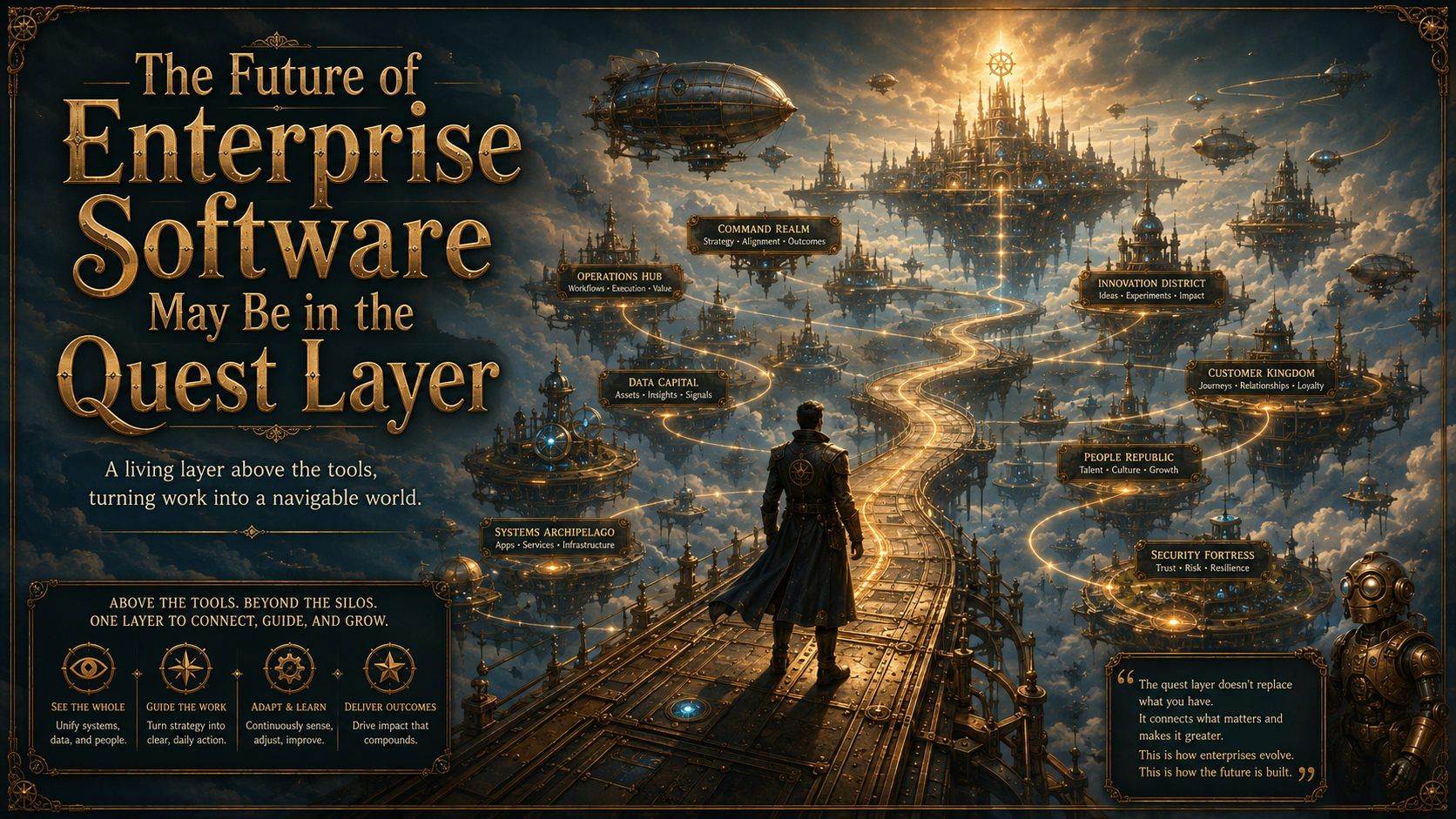
At some point in this whole thought experiment, I realized I was no longer just talking about dashboards.
That is how these things go. You begin with a perfectly reasonable complaint about status reporting, take one small conceptual step toward quest guides, add a Control Tower, involve several airships, and suddenly you are staring at the ceiling thinking, “Wait. Is the next generation of enterprise software actually a custom operating world?”
This is why one should be careful when pulling on metaphors.
Occasionally the metaphor pulls back.
Enterprise software has traditionally worked in one direction: the vendor defines the categories, and the organization adapts its work to fit them.
Here are your tasks. Here are your tickets. Here are your projects. Here are your dashboards. Here are your workflows. Here are your statuses, which will be green, yellow, red, or some other small emotional weather system.
This has been useful. I am not here to insult the entire software industry while standing on a stack of tools I use every day. Systems of record matter. Project management tools matter. Workflow engines matter. Dashboards matter.
But most of these tools are built around generic primitives, while real work is full of local language, institutional memory, context, culture, judgment, risk, evidence, ownership, and meaning.
The tool says, “task.”
The work says, “This is the dependency that unlocks the decision that allows the evidence to be accepted so the customer commitment can move without creating risk.”
A task field is a very small box for that much dragon.
This is where I think the next layer appears.
Not a replacement for the systems underneath, but a quest layer above them.
A quest layer is the live, role-aware, objective-aware operating view that connects the work people are doing across tools and turns it into something usable. It sits above dashboards, project plans, systems of record, tickets, docs, meeting notes, evidence repositories, BI, risk registers, and AI summaries.
It does not pretend those tools do not exist.
It makes them navigable.
The quest layer knows the objective, the current path, the party, the blockers, the decisions, the evidence, the risks, the owners, the confidence level, and the next best moves.
It is not another place to dump work.
It is the place where the work becomes coherent.
This is also where AI changes the shape of what is possible.
Before AI, building custom operating views around how a specific team thinks and works was expensive, brittle, and usually required either a heroic internal tools team or a vendor engagement that produced a marvelously expensive rectangle.
Now, with AI agents, connected data, app-generation frameworks, and better visualization tools, the old model starts to crack.
The future may not be, “Buy a tool and reshape the organization around it.”
The future may be, “Define the operating model, then generate the interface around it.”
That is a very different world.
It means a cybersecurity team can have a Trust Harbor. A product organization can have a Launch Constellation. A legal team can have a Case Foundry. A household can have ponies in stables, which I continue to maintain is both ridiculous and correct.
This is why I think game design and enterprise software are about to have a very interesting conversation in a hallway neither expected to be in.
Game designers understand something enterprise tools often flatten: people navigate complexity better when it has place, motion, role, inventory, consequence, and progression.
A game world can show the objective, the terrain, the active quest, the party, the available resources, the locked gates, the weather, the hostile territory, the side quests, and the thing you forgot to pick up three rooms ago.
Corporate work has all of that.
We just call it alignment, risk, dependencies, approvals, evidence, resource constraints, and “please see the attached tracker.”
The opportunity is not to turn work into a game.
The opportunity is to borrow the best cognitive patterns from games so complex work becomes visible enough to navigate.
This is also where the metaverse idea, which has spent several years wandering around wearing an expensive headset and looking for a business case, might finally become useful.
The killer use case was probably never “sit in a fake conference room with avatars and pretend this is better than Zoom.” The more interesting use case is spatial computing for complex coordination.
Not escapism.
Not novelty.
A real operating environment where people can move through objectives, see dependencies, understand risk, inspect evidence, coordinate with AI officers, and understand how their work contributes to the larger mission.
The better question is not, “Can we make corporate work look like a game?”
The better question is, “Can we make complex work navigable in the ways humans already understand movement, place, and story?”
That matters because the next phase of AI at work will not just be about individual productivity.
We are already drowning in individual productivity.
Everyone can draft faster, summarize faster, generate faster, and produce faster. Lovely. Also slightly terrifying.
But the coordination problem remains.
More output without shared context can easily become faster fog.
The organizations that win with AI will not simply be the ones with the most agents. They will be the ones that know how to coordinate humans and agents through live operating models.
They will know what the agents are doing, what signal they are maintaining, what work they are supporting, what decisions still require people, and what outcomes are actually being advanced.
That requires more than task lists.
It requires a quest layer.
The Zing Moment
Dashboards report the business.
Quest layers help people move through it.
Systems of record store the work.
Operating worlds make the work coherent.
AI can produce more artifacts, but the real unlock is using AI to maintain live context across people, systems, risks, evidence, and decisions.
We are no longer limited to the software categories vendors hand us. out of the box things we have to fit our work into and break horribly if we customize.
No more. Stahp. Get creative.
We can now build interfaces around the way our work actually works.
The future of enterprise software and people leadership and AI integration may not be another dashboard, another tracker, or another generic workflow.
It may be a living quest layer, connected to central command, shaped around the mission, and built so people can finally see the work they are inside.