3 of 5 in the series: The Quest Guide Era — Why Enterprise Work Needs More Than Dashboards
I have been noodling on this idea with my own team: if modern enterprise work needs a quest guide, then we probably have to admit we are already on a quest.
Which is inconvenient, because “quest” sounds much less corporate than “strategic cross-functional execution framework.” Unfortunately, it is also more accurate.
A quest has an objective. It also has uncertainty. You know what you are trying to achieve, but you do not always know the route, the blockers, the allies, the dependencies, the approvals, or the decisions you will meet along the way.
Which, if we are being honest, describes a great deal of enterprise work with almost suspicious precision.
So the practical question becomes this: how do you connect dashboards, project plans, systems of record, meeting notes, audit evidence, risk registers, decisions, and AI summaries into something usable for the people doing the work?
Not usable for the board.
Not usable for the quarterly readout.
Usable for the person inside the work who needs to know what changed, what matters, what is blocked, what decision was made, where the evidence lives, and what needs to happen next.
You reframe it.
That sounds suspiciously simple, but I do not think it is. Reframing is not decorating the work. Reframing is changing the mental model so the relationships become visible.
In my personal life, I had already been playing with this. I built a household operating system around ponies-as-agents living in stables that represented different workstreams. Food had a stable. Finance had a stable. Creative work had a stable. Household operations had a stable.
It sounds ridiculous until it works, and then it becomes the sort of ridiculous thing you defend with unreasonable conviction.
But when I looked at the work my team needed to accomplish, the ponies had to tap out.
Not because they lacked courage. They are excellent ponies.
But this work was more complicated. Cross-functional. Evidence-heavy. Executive-facing. Dependent on decisions, risks, audits, controls, technical constraints, customer trust, business velocity, and roughly sixty humans all moving through the fog with various lanterns.
This did not need a stable.
It needed a world.
So I built one.
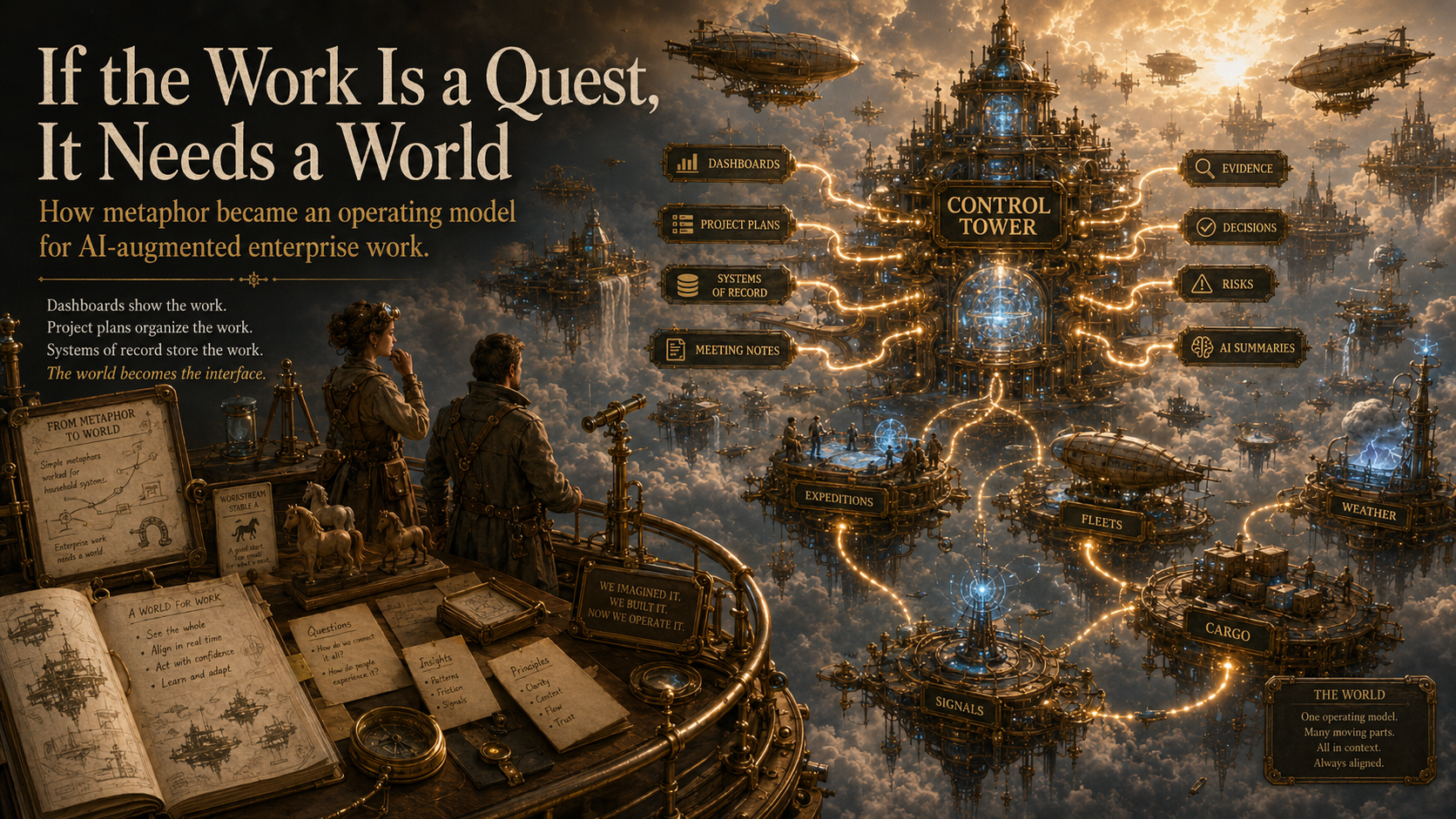
The metaphor became a steampunk sky harbor: a floating city of enterprise trust with a Control Tower at the center.
The annual objectives became expeditions. The durable security capabilities became fleets. The teams and workstreams became airships. The deliverables became cargo. Risks and blockers became weather. Evidence became sealed crates. Metrics became gauges and beacons. AI agents became officers helping route, summarize, inspect, and signal.
The moment it clicked, it stopped feeling like a theme.
It started feeling like an operating model.
The Control Tower mattered most because I already knew we needed an AI intake and output layer for decision intelligence.
If work is moving across meetings, documents, dashboards, project plans, systems of record, evidence folders, risk conversations, and executive decisions, then something has to keep the signal alive. Otherwise the organization becomes a very expensive game of telephone played by people with good intentions and incompatible calendars.
The Control Tower receives the signal: meeting minutes, decisions, blockers, evidence, risks, project updates, metrics, and AI summaries.
Then it sends signal back out: what changed, who needs to know, what is blocked, what decision is needed, what evidence is missing, what path is open, and what should happen next.
That is the shift.
Dashboards still matter. Project plans still matter. Systems of record still matter. They are not going away, nor should they. But they are not enough by themselves, because they were not designed to give people a living operating view of the work.
They become inputs.
The world becomes the interface.
And once you have a world, you can finally start asking better questions.
What are the expeditions? Who are the fleets? What cargo is moving? Where is the weather forming? Which decisions unlock the next path? Which evidence proves readiness? Which AI agents are keeping the questers updated and current?
Because the real goal is not to make work fantastical.
The real goal is to make complex work visible enough that people can move through it together. And honestly — that is a pretty fantastical job.
The Zing Moment:
A dashboard can show status.
A project plan can show tasks.
A system of record can show artifacts.
But an operating world can show how the work is actually moving.
And for complex, cross-functional, AI-augmented work, that may be the difference between reporting progress and actually navigating it.