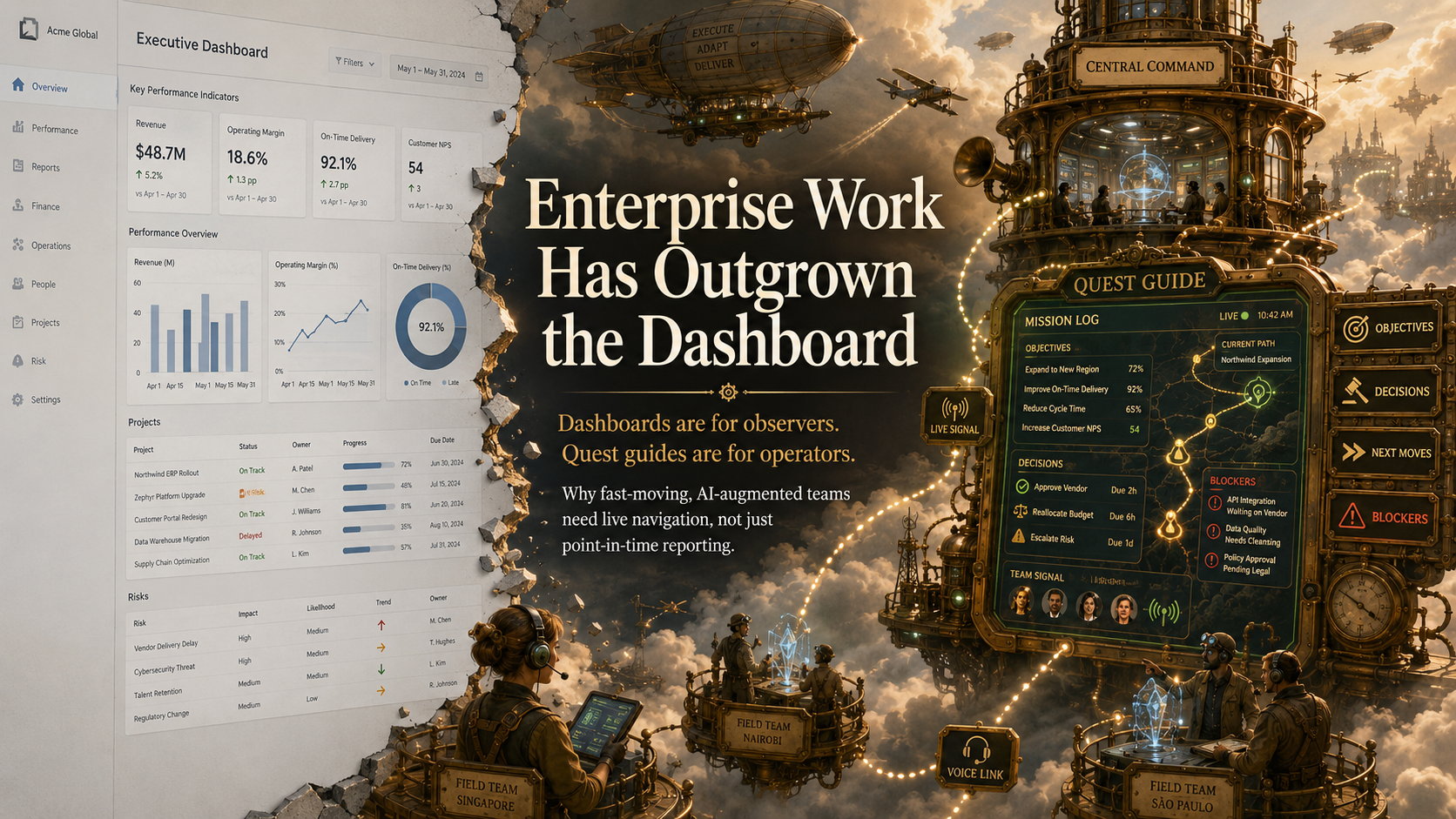
1 of 5 in the series: The Quest Guide Era — Why Enterprise Work Needs More Than Dashboards
I love a good dashboard. Truly. I am not here to drag the humble dashboard into the street and accuse it of crimes against humanity, partly because dashboards are useful and partly because humanity has committed far stranger crimes with pivot tables.
Dashboards serve a real purpose. Boards need them. Executives need them. Oversight groups need a point-in-time readout that says, “Here is where things stood when we gathered the data, checked the colors, assembled the slide, and sent it around for review.” That is not nothing. A clean dashboard can be clarifying, especially when the alternative is six people describing the same initiative in slightly different shades of corporate fog.
The problem is that somewhere along the way, we started asking dashboards to do more than report the work. We started asking them to guide the work.
That is where the wheels begin to wobble, rattle, and eventually roll off into the shrubbery.
A dashboard tells observers what happened. A quest guide helps operators decide what to do next.
That distinction matters because the people inside the work are not standing on a balcony with binoculars, admiring the general shape of the kingdom. They are in the mud, holding the rope bridge, trying to figure out whether Legal approved the crossing, whether Security reviewed the controls, whether Product changed the timeline, whether the evidence is complete, and whether the person who owned the dependency has quietly wandered into another meeting and become unreachable until Thursday.
Static reporting is for people watching the work.
Quest guidance is for people inside the work.
A point-in-time report can be perfectly accurate and still be stale by the time the team receives it. That is not because anyone failed. It is because modern enterprise work moves with too much velocity and too many participants to be fully represented by a frozen artifact.
Decisions happen between meetings. Dependencies shift. Risks improve, worsen, mutate, or put on a little hat and introduce themselves as “just a timing issue.” One team unblocks something while another team unknowingly creates a new blocker three systems away. By the time the readout lands, it may still be true, but the terrain has already changed.
This is why I keep coming back to the idea of a quest guide.
In a quest, you know what you are trying to achieve. You do not always know the route, the blockers, the allies, or the decisions you will meet along the way. That is very much how corporate objectives work, despite our heroic efforts to make them sound tidy.
We begin the year with goals, priorities, milestones, and a sincere belief that the calendar will behave. Then reality enters the room carrying a bag of ferrets. The objective still matters, but the path has to adapt.
The team needs the current state. The known blockers. The open decisions. The contributors. The dependencies. The proof already collected. The next best move.
Not last month’s weather report.
Not a red-yellow-green shrine.
Live navigation.
AI makes this possible in a way that was not practical before. Not because AI magically fixes the work, and certainly not because we need another cheerful robot producing 400-word summaries of meetings that should have been emails and somehow were neither.
AI matters because it can help keep signal fresh across meetings, documents, tasks, evidence, decisions, risks, and metrics. It can maintain the quest log. It can flag stale assumptions. It can route updates to the people who need them. It can connect the artifact to the objective, the blocker to the owner, the decision to the evidence, and the evidence to the outcome.
Humans remain accountable, because this is work and not a vending machine. But AI can help keep the operating picture current so people are not navigating with a map drawn before the bridge washed out.
The Zing Moment: enterprise work has outgrown the idea that reporting is enough.
Reporting still matters. But reporting is not guidance.
A dashboard tells us what happened.
A quest guide helps us move through what is happening.
A point-in-time report is a snapshot. Modern teams need live navigation.
So the question I am interested in now is not whether we need better dashboards. We probably do. We always do. The corporate world will never run out of reasons to make another dashboard.
The bigger question is far more interesting:
What if the next interface for enterprise work is not another dashboard, but a quest guide connected to central command?