4 of 5 in the series: The Quest Guide Era — Why Enterprise Work Needs More Than Dashboards
If teams are working through quests, then AI cannot just be another enthusiastic productivity machine producing artifacts in the corner.
I say that with affection. I love a useful AI assistant. I love a draft. I love a calendar summary first thing in the morning.
But if AI only helps us produce more words, tickets, notes, updates, and summaries, we have not solved the coordination problem.
We have simply upgraded the fog machine.
The real opportunity is not just AI productivity.
It is AI-supported coordination. Like a central nervous system communicating the right information to the right players quickly so they can make quality decisions on behalf of the business.
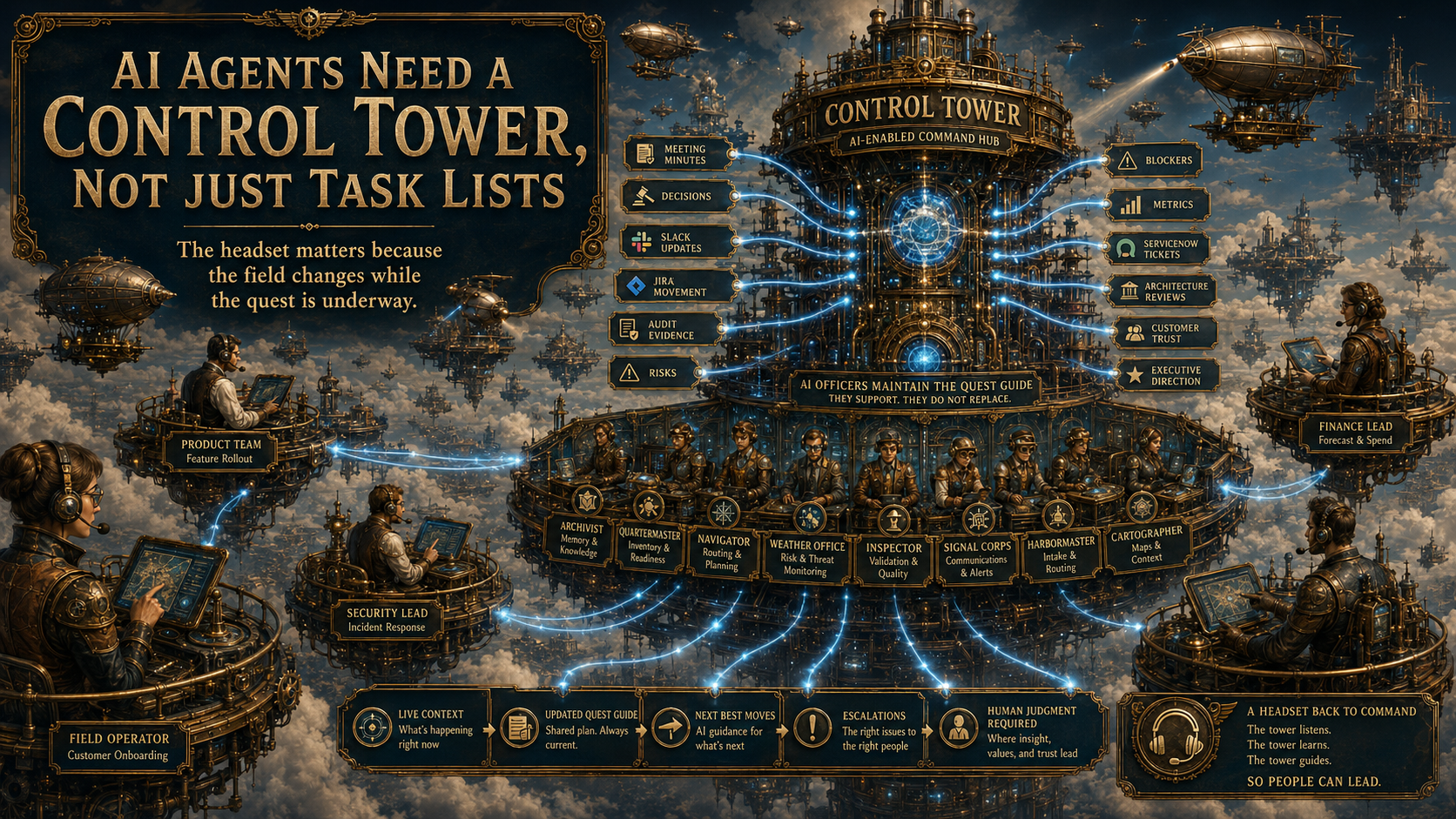
If the team is in the field, moving through live work, then the AI layer should function less like a random collection of task rabbits and more like a headset back to central command.
Every person doing the work should be able to understand what changed, what matters, what is blocked, who needs signal, what decision was made, what evidence exists, and what needs human judgment next.
The headset matters because the field changes while the quest is underway. The route shifts. The weather turns. The bridge that looked solid on Tuesday is now awaiting approval from someone who is, spiritually speaking, in a different biome.
This is where the Control Tower comes in.
The Control Tower does not do the mission for the team.
It keeps the operating picture current.
It receives signal from the places where work actually happens: meeting minutes, decisions, Slack updates, Jira movement, audit evidence, risks, blockers, metrics, ServiceNow tickets, architecture reviews, customer trust asks, executive direction, and all the little “wait, did we decide this already?” fragments that usually scatter into the organizational wind.
Without a Control Tower, those fragments become folklore.
With one, they become live context.
A team with AI but no Control Tower is just generating faster fog. Everyone gets a copilot. Everyone gets summaries. Everyone gets drafts. And somehow the organization still cannot answer the basic questions.
What changed?
Who owns this?
What is blocked?
What decision unlocks the next step?
What proof do we have?
Which risk is real, and which one is just wearing a dramatic cloak?
This is why AI architecture cannot stop at task automation. AI should not only help us produce more artifacts. It should help us maintain the operating picture.
In this model, AI agents maintain the quest guide. And we can make up silly roles for them in this world — because it is our world and we are creating it, and our imaginations are a bit dusty at this point in our careers.
In this world:
The Archivist captures decisions, notes, evidence, and source links.
The Quartermaster tracks deliverables and missing artifacts, because no quest has ever been improved by discovering at the gate that someone forgot the rope.
The Navigator maps dependencies and next steps.
The Weather Office detects risks, blockers, and stale assumptions.
The Inspector checks evidence quality and readiness.
The Signal Corps sends updates to the right stakeholders.
The Harbormaster routes intake and escalations.
The Cartographer maintains relationship maps across teams, systems, objectives, and the people who somehow became load-bearing without realizing it.
None of these agents replaces human accountability.
They make accountability easier to exercise because the context is no longer dissolving under everyone’s feet.
That distinction matters.
Humans remain accountable. AI keeps the quest guide current.
Humans make decisions, accept risk, prioritize work, resolve tradeoffs, and bring judgment to the messy places where there is no perfect answer hiding helpfully in the shrubbery.
AI gathers, connects, summarizes, inspects, routes, and reminds.
The Zing Moment: a team with AI and no Control Tower is just generating faster fog.
The real unlock is not more AI output.
It is AI that maintains live context — so when the field changes, the operating picture changes with it, and the humans who need to act actually know what to do next.