2 of 5 in the series: The Quest Guide Era — Why Enterprise Work Needs More Than Dashboards
Corporate work is already a quest.
It’s just a bit difficult to tie together because “quest” sounds unserious, while “cross-functional strategic alignment initiative” sounds like something that will get you a promotion.
But structurally, the quest metaphor is much closer to reality — because if you have never observed that Q4 is every end-of-season boss battle, you aren’t using your creativity enough.
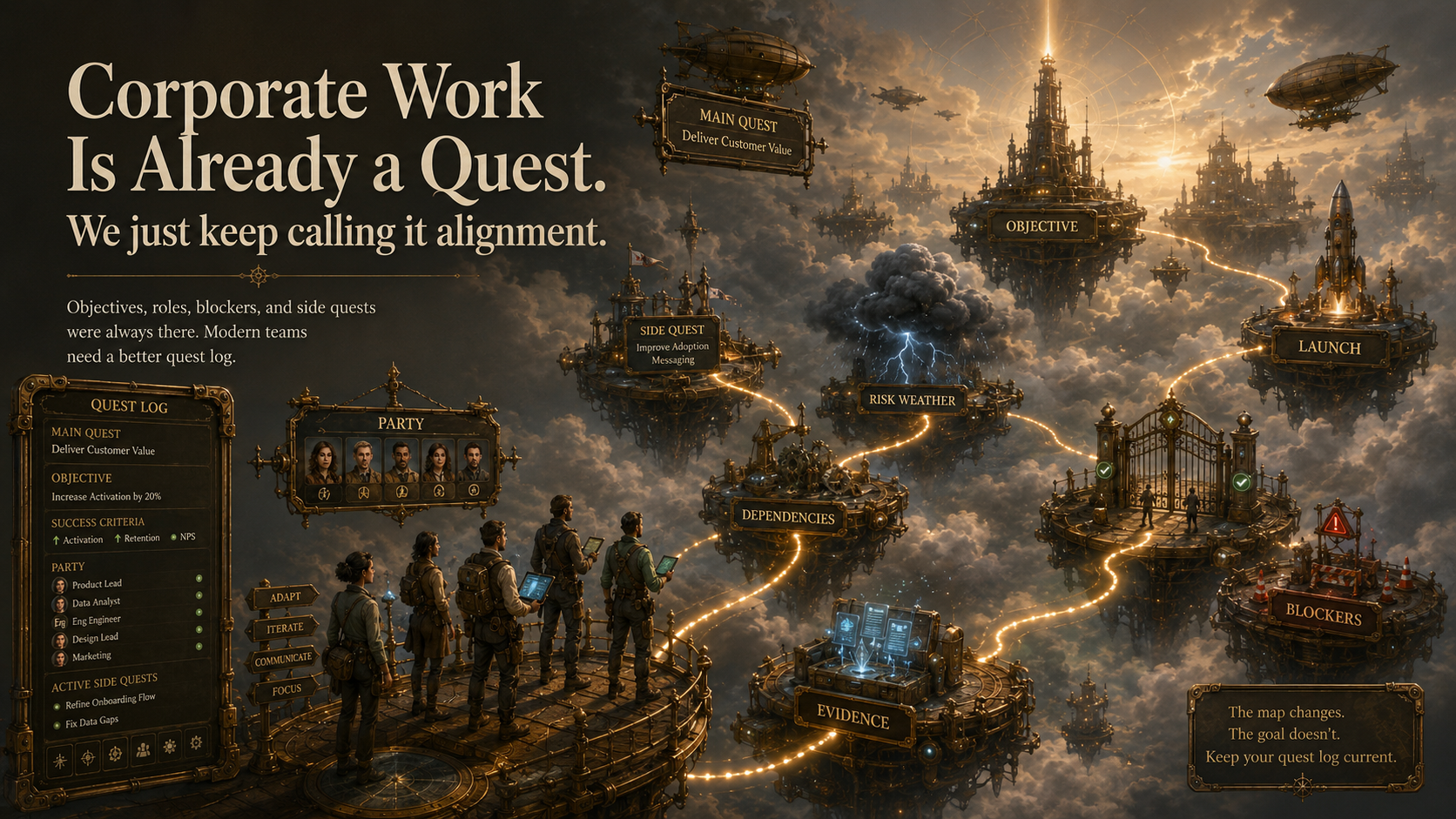
You have an objective. You have a party. You have specialized roles. You have terrain no one fully understands at the beginning. You have dependencies, artifacts, delays, risks, approvals, surprise stakeholders, and occasional boss fights disguised as audits, executive reviews, customer escalations, or “quick syncs” that somehow involve twelve people and a poorly drawn diagram.
This is especially true in complex enterprise work, where the objective is usually clear enough to name but not always clear enough to complete without discovery.
We know we need to close identity gaps, improve data security, migrate platforms, enable certification, automate evidence collection, reduce risk, or improve operational efficiency. Wonderful. There is the mountain.
But the route up the mountain is rarely a tidy dotted line.
It changes as teams learn more. It changes when a dependency is not actually owned by the person everyone assumed owned it. It changes when a tool cannot do what the vendor said it could do during the demo. It changes when Legal needs another pass, Finance has feelings, Architecture finds a hidden dragon in the basement, or the business decides the timeline is now “yesterday, but strategically.”
This is why calling everything “alignment” can flatten the real nature of the work.
Alignment matters. Of course it does. Alignment answers the question, “Are we pointed in roughly the same direction?”
But quest guidance answers better questions.
Who has the tools? Who has the light? Which dependency has gone out? What decision unlocks the next path? What proof have we collected? Why is there smoke coming from the compliance wagon?
A team does not only need agreement on the objective. It needs live awareness of the changing path.
It needs to know which work matters now, which dependency is blocking movement, which artifact is missing, which decision changed the route, and which people or systems must be pulled into the party next.
The danger, of course, is that people hear “quest” and immediately imagine cheap gamification.
Points. Badges. Leaderboards. Compliance confetti. Someone in a cape shouting “Level up!” because a policy exception was closed.
No.
Absolutely not.
I am not trying to turn corporate work into a novelty arcade where grown adults collect sparkle coins for attending governance meetings.
I mean something more practical: using quest logic to make complex work navigable. And interesting.
Quest logic gives people a way to understand objectives, roles, blockers, inventory, dependencies, risk, progress, and next actions. It gives the work shape without pretending the work is simpler than it is.
And once you see it, it is everywhere.
A strategic objective is the main quest. Cross-functional workstreams are side quests — except some of the side quests are secretly load-bearing.
Evidence is inventory.
Decisions are unlocks.
Risk is weather.
Approvers are gatekeepers.
Dependencies are bridges.
Technical debt is the ancient curse everyone inherited from the previous civilization.
And the end-of-year performance review is where everyone tries to reconstruct the heroic journey from Slack messages, meeting notes, ticket updates, and the vague memory that sometime in April they saved a project from becoming a flaming wheelbarrow.
This is the part I think matters most.
Work does not need to become a game.
Work already has quest structure.
The opportunity is to stop managing that structure through scattered artifacts and start giving teams a living quest guide.
Not because quests are cute.
Because people inside complex work need to know where they are, what changed, what matters, what is blocked, who is involved, what proof exists, and what to do next.
That is not gamification.
That is operational clarity wearing a funner hat.
The Zing Moment: corporate work is already a quest.
We just keep calling it alignment because it looks better in a QBR.
But alignment only tells us whether we are facing the same mountain.
A quest guide helps us climb it.