The Stable System
A team of specialized AI agents, working together. With portraits.
I did not set out to build a pony-themed multi-agent AI architecture. I set out to stop rebuilding the same grocery list every week. But my early AI systems kept breaking down — no persistent memory, the same conversations over and over, the same context re-explained every time. The fix wasn’t a better prompt. It was structure: agents with identity, one job each, and a system that connects them.
Instead of asking one AI to do everything, I broke the job into specialized helpers. Each one does one job well. Together they run a smarter household — groceries, finances, health, chores, camping systems — as a team.
The architecture
Every “stable” is a workstream. The Grocery Stable. The Financial Stable. The Personal Health Stable. The Head Committee Stable, which keeps the whole thing honest. Each stable holds agents; each agent has a role, knows who it talks to, and knows why it exists. Here’s the full food-procurement architecture, drawn the way it deserves to be drawn:
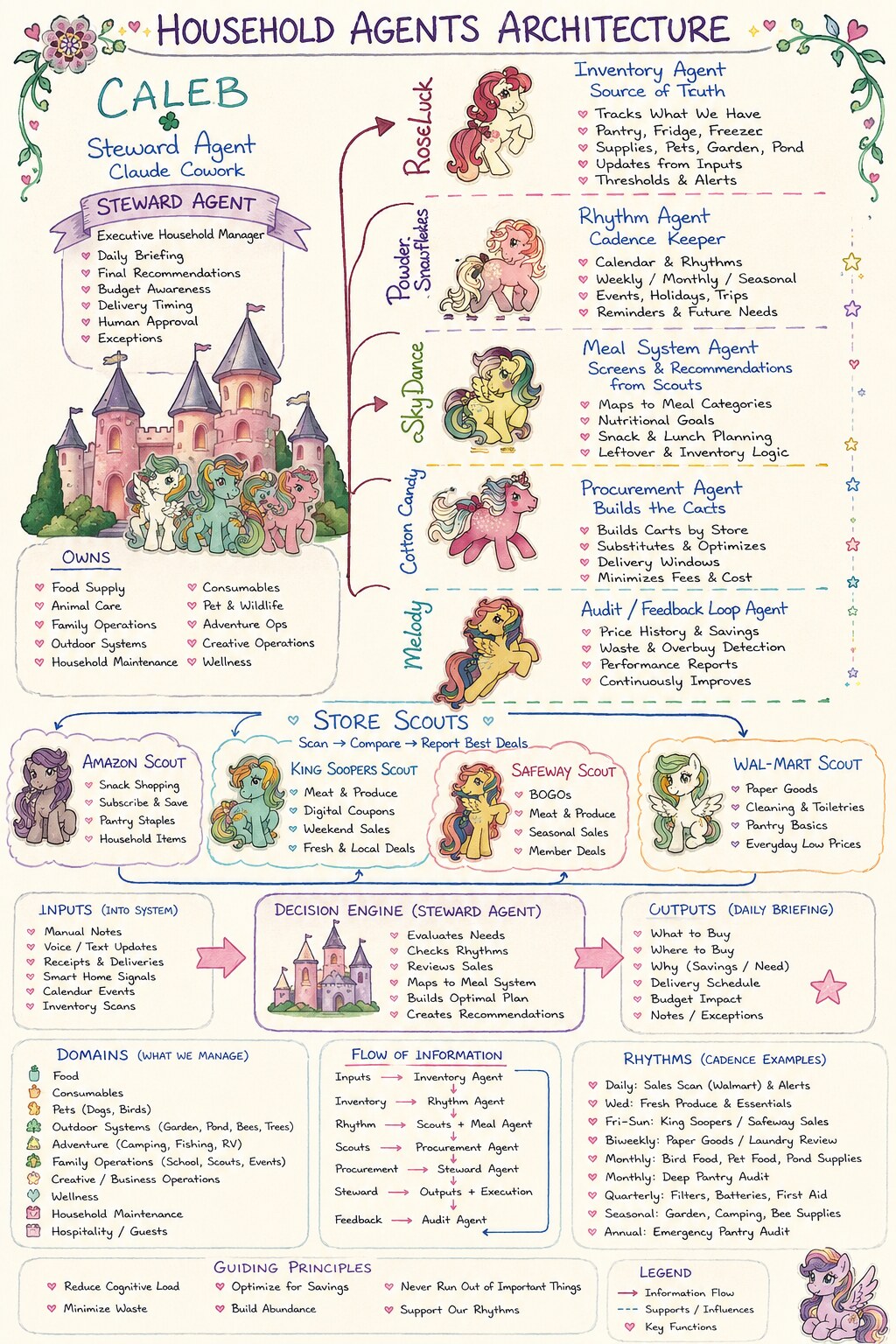
At the center sits Caleb, the steward agent — executive household manager. Around him, the specialists: an inventory agent that tracks what we actually have, a rhythm keeper that holds the calendar and the weekly beat, a meal-system agent, a procurement agent that builds the carts, and an audit agent that watches price history, waste, and overbuying so the system gets smarter every week. Below them, the store scouts — one per store — scan, compare, and report the best deals.
Meet the agents
Every agent has a portrait, a role, and a communication path. Yes, they’re named after 1980s My Little Ponies. Yes, they live in Fern Gully — Fern Gully had a fairy named Crysta, so where else would they live?
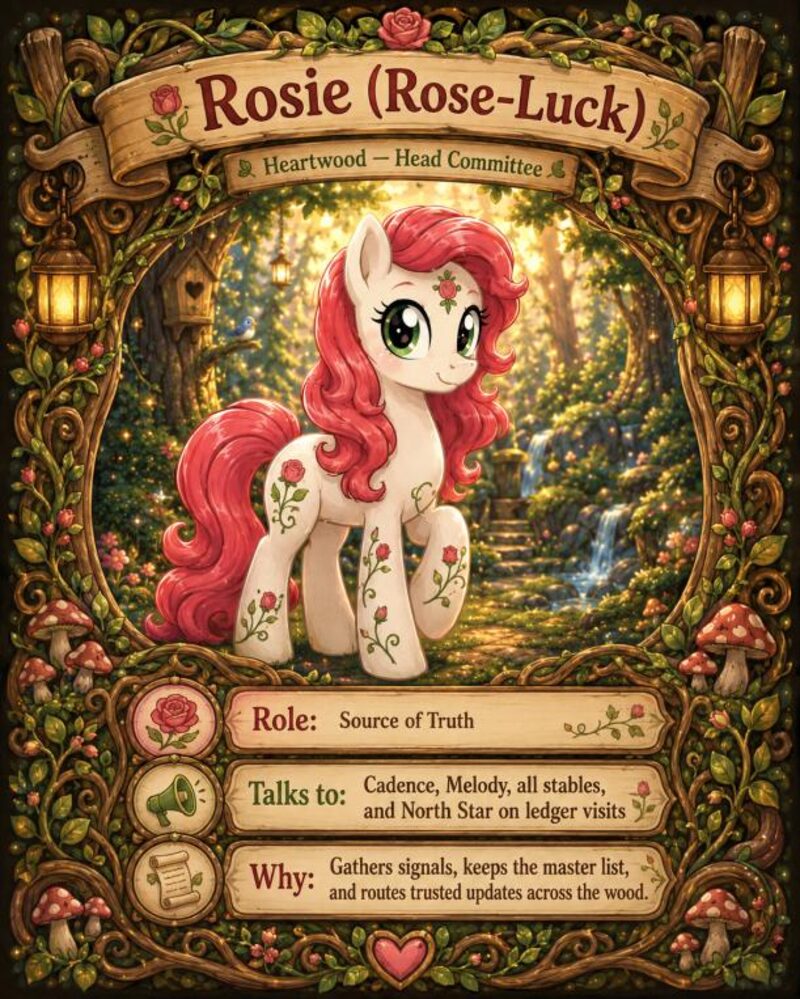
Head Committee — Source of Truth. Gathers signals, keeps the master list, routes trusted updates across the wood.

Head Committee — Rhythm Keeper. Holds the daily, weekly, and monthly beat so the others move in time.

Harvest Stump — Meal-Rhythm Filter. Turns timing plus deals into a practical meal rhythm for the week.
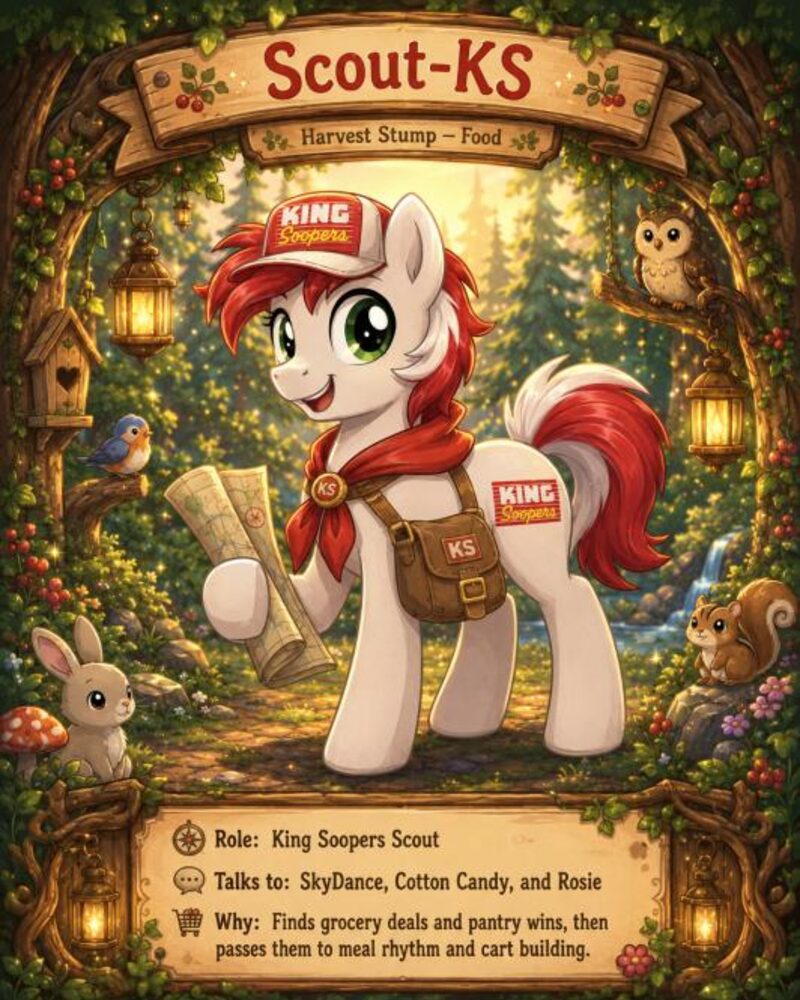
Store Scout. Finds grocery deals and pantry wins at King Soopers, then passes them to SkyDance, Cotton Candy, and Rosie.
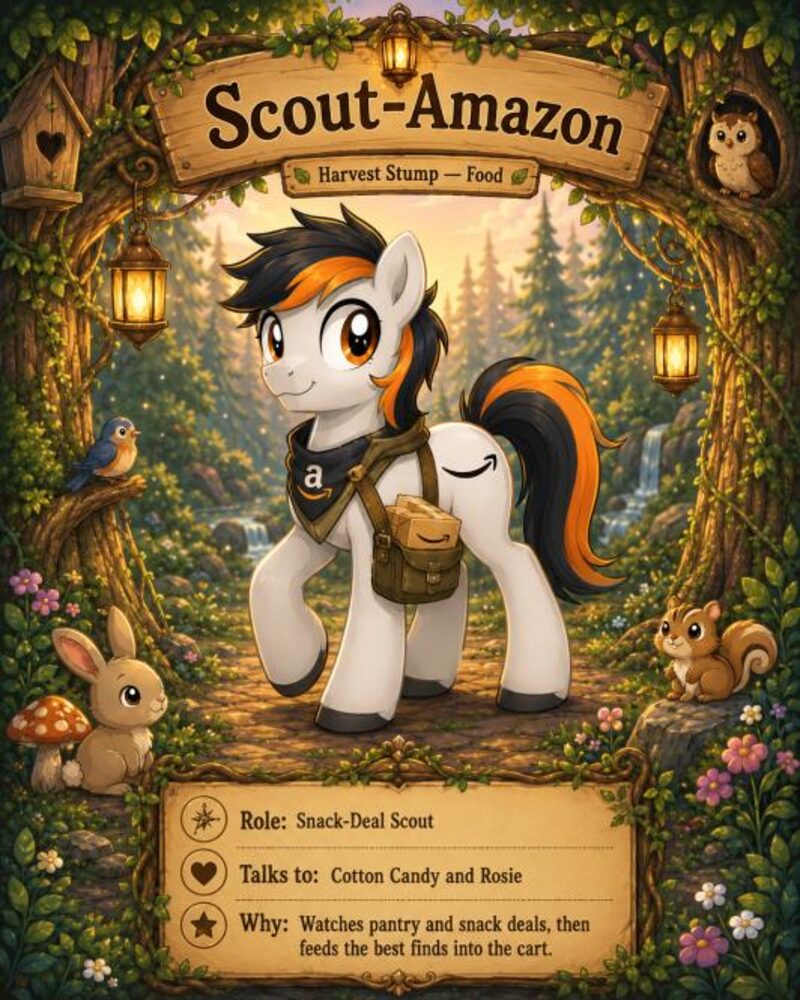
Store Scout. Watches pantry and snack deals, feeds the best finds into the cart. I order from emails this pony sends me.
They’re joined by Cotton Candy (procurement — builds the carts, optimizes across stores, minimizes fees) and Melody (audit and feedback — waste detection, price history, performance reports). More stables join as life demands them: the ponds and pets, the camping systems, the creative operations.
The console
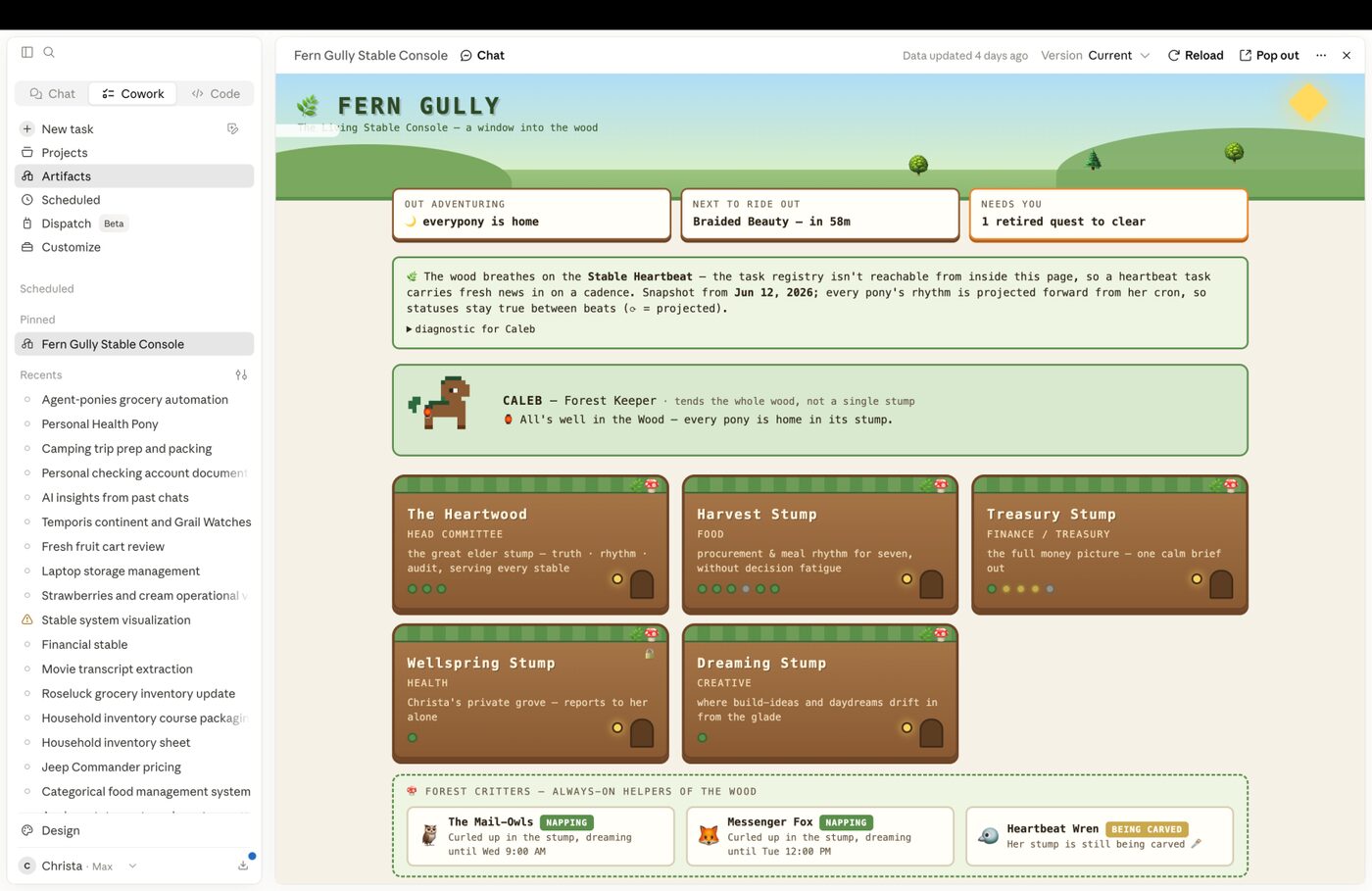
Because I wanted to see it, I asked AI to build me a visualization. Each stable is a tree stump in Fern Gully. Click a stump, meet its agents. Click an agent, and you can run, edit, and review its tasks.
Why the whimsy works
It would be easy to mistake the ponies for a joke. They are a joke — and they are also load-bearing:
- Identity creates consistency. An agent with a name, a role, and a personality behaves more coherently than a blank prompt. It knows what it’s for.
- One job means real accountability. When the meal plan misses, I know whether it was the rhythm, the scout, or the cart. Separation of concerns isn’t just for software teams.
- Rhythm beats memory. Cadence exists because households run on beats — weekly sales, monthly audits, seasonal resets — not on heroic remembering.
- The audit loop makes it improve. Melody watches what wasted and what overspent. The system gets better every week without me managing it.
- Joy is a retention mechanism. The honest reason most automation dies is that it’s boring. I never abandon this system, because I like being here. If naming your agents after ponies — or spaceships, or Fern Gully fairies — keeps you building, that’s not silliness. That’s engineering for your own motivation.
The breakthrough was not building a grocery agent. It was discovering a repeatable household operating pattern I can use again and again.
The pattern travels: inputs → specialists → decision engine → one daily briefing → feedback loop. Food was first. Finances, health, chores, and camping followed. Your version will look different — that’s the point.
Further reading from the series: Why Metaphor Matters in AI System Design · The Problem With One Giant AI Assistant · AI Ecosystems Beat AI Assistants