The Automated Household
A home is an operating system too.
You can't automate a life you haven't defined.
This isn't about productivity. It's about work-life balance you can actually feel, creativity that survives adulthood, and getting radically honest about what you want to do with your one life — so you can automate or outsource the rest. With AI, anyone can do this now. And if thinking about it creatively helps, lean all the way in. I did.
What you think you're managing vs. what you're actually carrying
Mothers make over 1,000 micro-decisions a day — a mental load nearly three times greater than before having children. Most of it is invisible. Nobody assigned it. It just accumulated.
The Visible Work
- Making the grocery list
- Cooking dinner
- Assigning chores
- Checking the family calendar
The Invisible Work
- Knowing what you're out of before you check
- Who likes what, allergies, special occasions
- The weekly rhythm of what needs replenishing
- What wasted last week, and why
- Competing schedules, priorities, and the budget
AI can carry a remarkable amount of that invisible load — not the love, not the judgment, not the presence. The remembering, the sorting, the reconciling, the first drafts of everything.
What makes you feel alive?
Before I automated anything, I sat down with one uncomfortable question: who are you, and what are you trying to accomplish? It took a solid week. Years of being flexible for everyone around me meant I could no longer say what I wanted from my own free time — even when I had some.
What I found was that I'm motivated by aliveness. And once I could name what made me feel alive, I could finally see what didn't — meal planning, grocery logistics, inventory in my head — and those became honest candidates for real automation.
Five questions to sit with: What do I wish I was doing more of? What do I value? Where am I wasting time? How do I maximize time on what I want? What do I want to get good at?


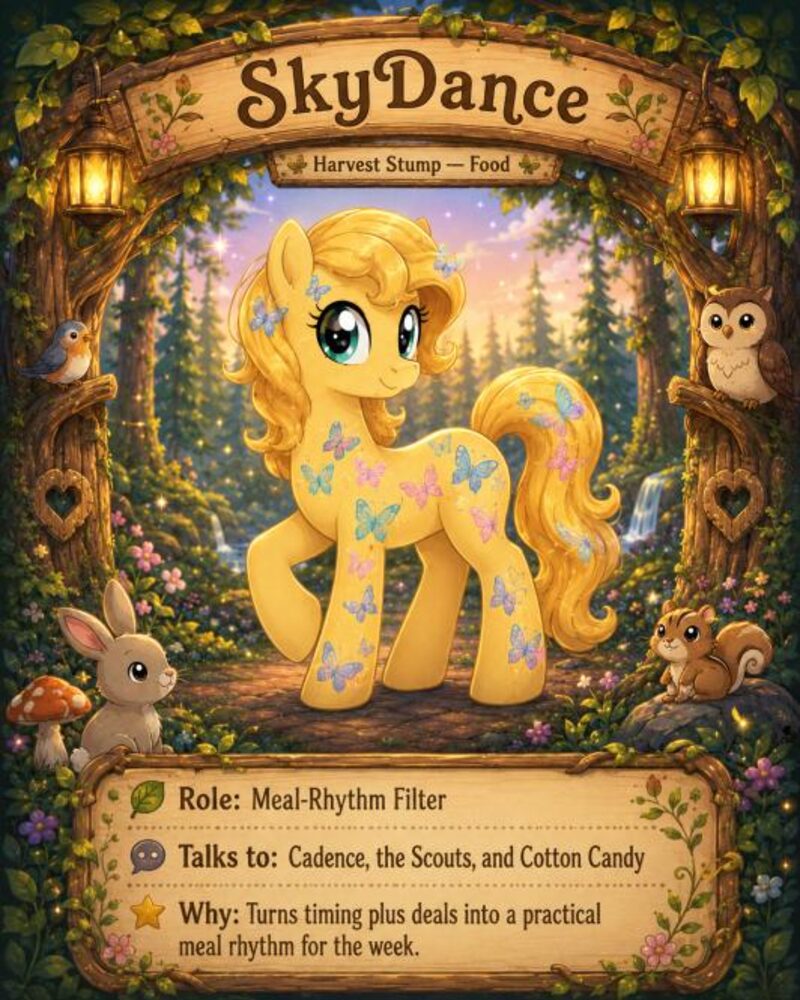
Yes, they're ponies. That's the point.
My household runs on a team of specialized AI agents — each with one job, a name, a personality, and a portrait. They're named after 1980s My Little Ponies, organized into "stables" by workstream, and they live in Fern Gully. (Fern Gully had a fairy named Crysta. Naturally.)
The whimsy isn't decoration. It's engineering. Identity gives agents consistency. Separation gives them focus. And joy is what makes a system you actually keep using.
Tour the StablesThree ways in
The Stable System
What it is and why it works: stables as workstreams, agents with identity, a decision engine, rhythms, and an audit loop. The full architecture — portraits included.
Meet the Agents →
Build Your Own
From the 60-second emergency dinner prompt to a system that runs on rails. The exact prompts, the meal rhythm, and the steps — no engineering degree required.
Start Tonight →
The Field Guide Vault
The full workshop deck plus four worksheets: find your first use case, build your first agent skill, and design your own household system. One email opens all five.
Open the Vault →"AI should not replace care. It should reduce the invisible scaffolding around care so the human can be more human."
— Christa Burger