Quest Layer ✦ Series
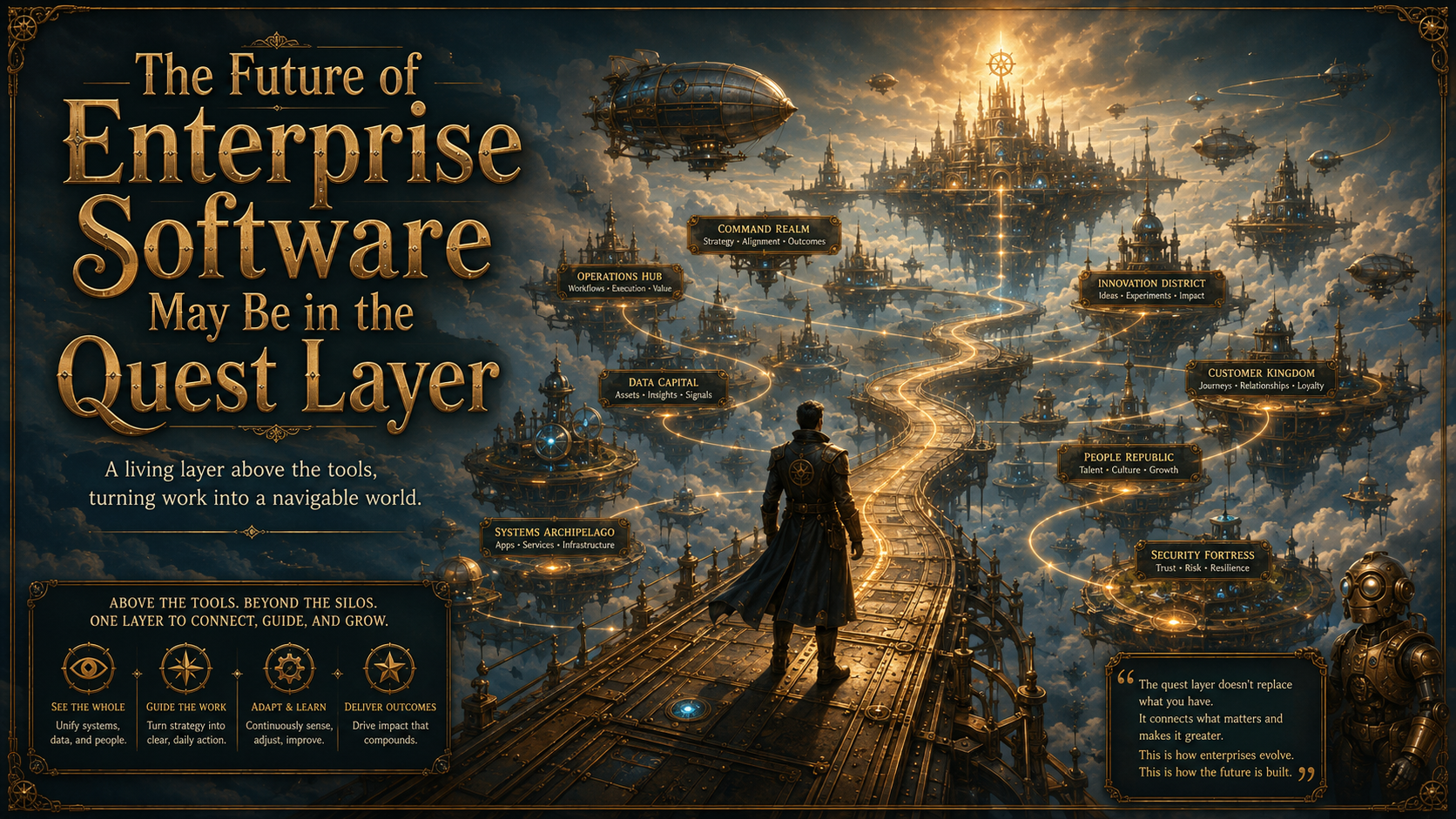
The Future of Enterprise Software May Be in the Quest Layer
We are no longer limited to the software categories vendors hand us. We can now build interfaces around the way our work actually works.
Cybersecurity executive. Systems builder. I build operating systems that build and reinforce trust — and I have spent more than twenty years working inside the places where trust is not theoretical.
Most governance looks perfectly respectable until something goes wrong. I build for the other day.

It is the distance between who we say we are and who our behaviors, incentives, controls, decisions, defaults, and evidence prove us to be. A risk register can name the concern, but it cannot by itself change the operating reality that created it. The deeper work is building systems around the governance — decision rights, escalation paths, evidence loops, accountability structures, metrics, defaults, control points, and rhythms that reinforce the behavior the organization actually wants.
Independent assessment of first-line work. Risk appetite statements, key risk indicators, and the judgment to escalate an emerging risk before the incident rather than after it.
The Governance Writing →Turning complex work into accountable decision systems: who decides, what values guide it, what risk is acceptable, how accountability flows, and how the system changes when reality changes.
How I Build It →Residual risk in thirty seconds. Reporting that survives a board risk committee and an examiner in the same week — technical truth translated without being diluted.
Speaking to Boards →AI governance past the policy document: identity, intent, limits, drift detection, and succession for systems that act. The frontier lane of the practice, and the one boards are asking about now.
The AI Governance Work →We are no longer limited to the software categories vendors hand us. We can now build interfaces around the way our work actually works.
The point of AI is not to become a more efficient toaster.
Remembering is work. Noticing is work. It is just badly marketed.
The late-night save is a signal: a broken system relying on one person's goodwill.
The right metaphor isn't decoration. It's how you know what you are building.
Governance isn't a compliance checkbox. It's the architecture of accountability.
"Trust is built by creating systems that reinforce desired outcomes and behavior — even under stress and disorganization."
— Christa Burger
I have spent fourteen years on a board of directors and a career presenting risk to executives who need the answer in thirty seconds and the reasoning available on request. I speak to boards, executive teams, and security and risk organizations on governance, AI risk, and the operating models that hold.
Recent keynotes include Governance for the World That Actually Exists, From AI Ambition to Accountable Operating Model, and Well-Formed Agents: Identity, Intent, Drift, Limits, and Succession.
Speaking & WorkshopsGovernance without theater, AI without hype, and the operating models that survive contact with reality. Written for the people accountable when it goes wrong.